OCC-FAS Dataset

OCC-FAS reframes occluded face anti-spoofing by treating benign accessories as valid live presentations while isolating malicious spoof cues in full and partial attack settings.

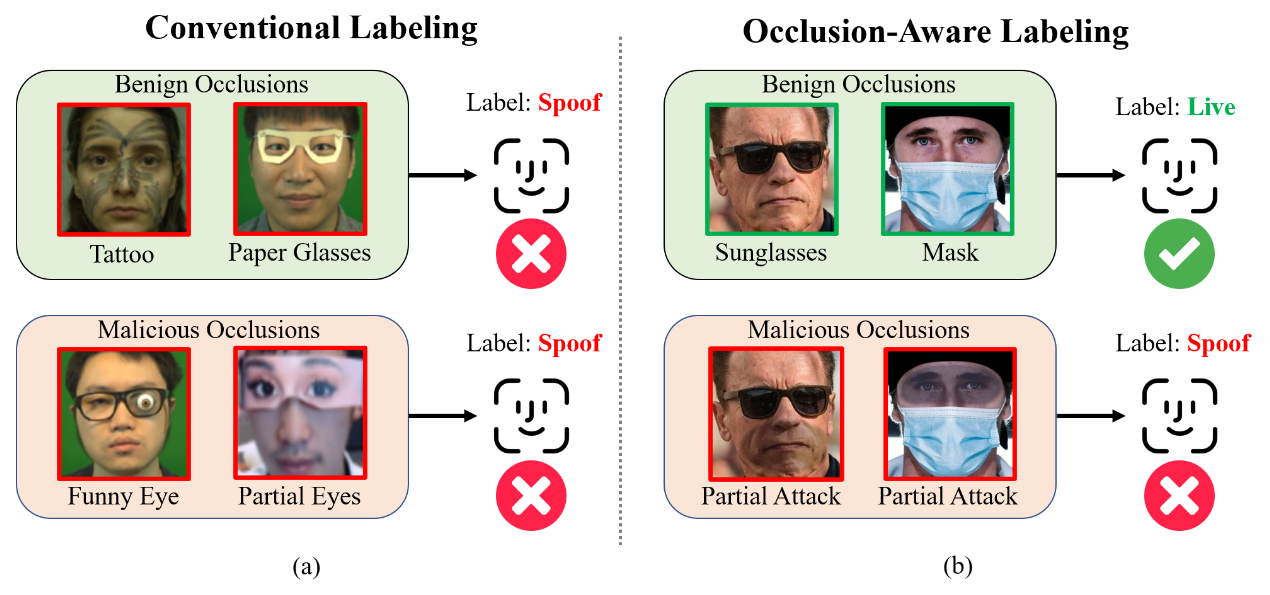
Occlusion-aware labeling

Masks and sunglasses are modeled as real-world live conditions, not automatic spoof evidence.

Partial-attack coverage

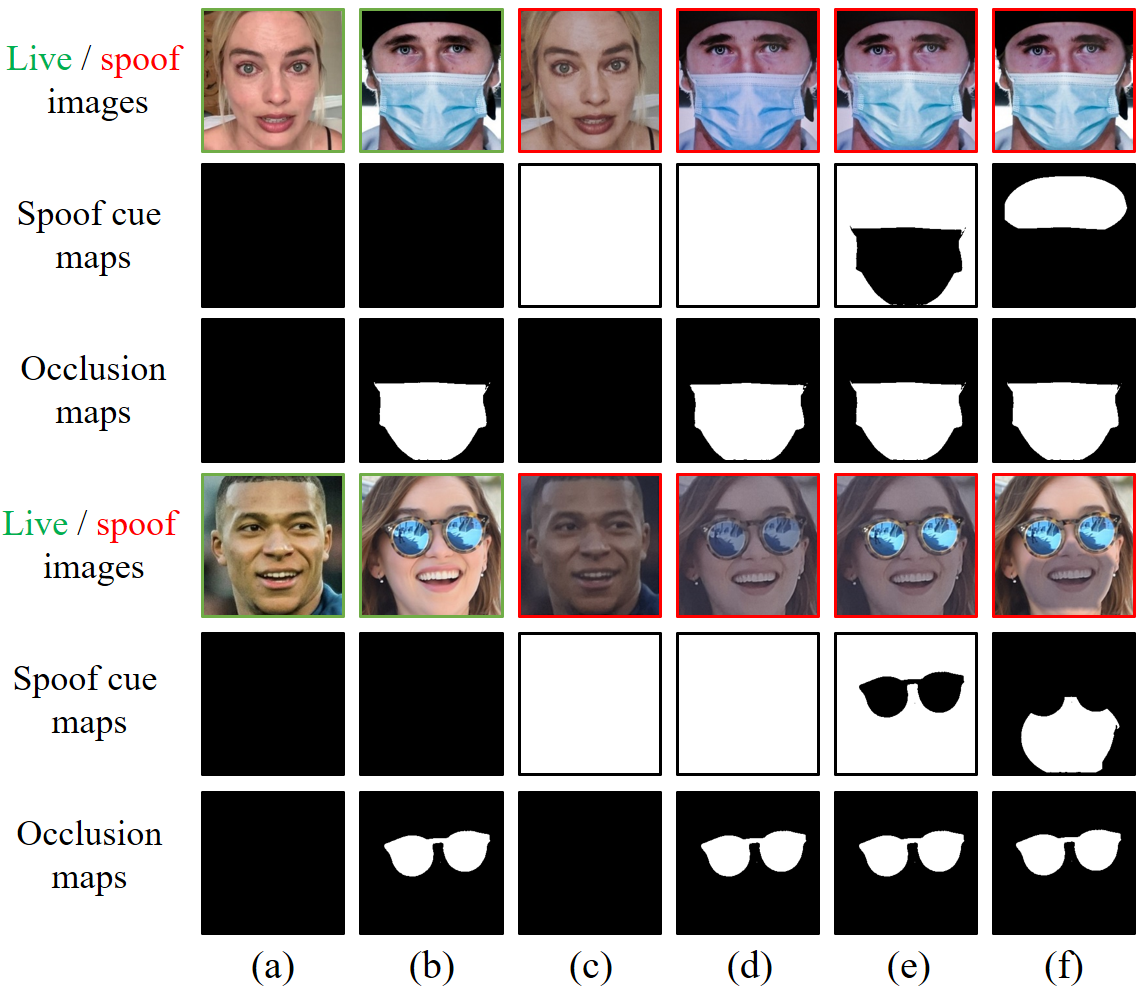
Six scenarios span live, full spoof, spoofed occlusion, real occlusion, and hybrid live-spoof cases.

Spatial supervision

Spoof cue maps and occlusion maps provide pixel-level ground truth for localized liveness learning.
1,920 Samples 160 live / 1,760 spoof
6 Scenarios LF to SF-LF-RO cases
3 Protocols 9 sub-protocols
2 Annotation Maps Spoof and occlusion cues

Occlusion-Aware Labeling

Fig. 1: Conventional vs. Occlusion-Aware Labeling.

The left panel shows the conventional rule: any unusual occlusion on a genuine face, such as tattoo-like marks or paper glasses, is treated as spoof. The right panel shows the OCC-FAS rule: benign real-world accessories such as sunglasses and masks remain live, while malicious partial attacks are still labeled spoof. The check and cross marks indicate how the same visible obstruction should be interpreted depending on whether it is benign or attack-driven.

Six OCC-FAS Scenarios

Fig. 2: Examples of live and spoof samples across the six OCC-FAS scenarios.

Columns (a)-(f) correspond to LF, LF-RO, SF, SF-SO, SF-RO, and SF-LF-RO. Green boxes denote live samples and red boxes denote spoof samples. For each identity, the two black-and-white rows underneath separate the annotation targets: spoof cue maps mark attack regions, while occlusion maps mark benign accessories such as masks or sunglasses. This layout shows why OCC-FAS tests both image-level live/spoof decisions and localized reasoning about where spoof or occlusion evidence appears.

LF
Live Face
LF-RO
Live Face with Real Occlusion
SF
Spoof Face
SF-SO
Spoof Face with Spoof Occlusion
SF-RO
Spoof Face with Real Occlusion
SF-LF-RO
Spoof Face Mixed with Live Face under Real Occlusion

Detailed Configuration of the Evaluation Protocols

Protocol Subset Scenarios Attack Light Camera Live # Spoof #
I-a Train All Print, Replay Bright C2 96 264
Dev All Print, Replay Dark C1 32 88
Test All Print, Replay Dark C1 32 88
I-b Train All Print, Replay Dark C1 96 264
Dev All Print, Replay Bright C2 32 88
Test All Print, Replay Bright C2 32 88
II-a Train All Print Bright, Dark C1, C2 96 528
Dev All Replay Bright, Dark C1, C2 32 176
Test All Replay Bright, Dark C1, C2 32 176
II-b Train All Replay Bright, Dark C1, C2 96 528
Dev All Print Bright, Dark C1, C2 32 176
Test All Print Bright, Dark C1, C2 32 176
III-a Train LF, LF-RO, SF, SF-SO Print, Replay Bright, Dark C1, C2 96 480
Dev All Print, Replay Bright, Dark C1, C2 32 352
Test All Print, Replay Bright, Dark C1, C2 32 352
III-b Train LF, LF-RO, SF, SF-SO Replay Bright C2 96 60
Dev All Print Dark C1 32 44
Test All Print Dark C1 32 44
III-c Train LF, LF-RO, SF, SF-SO Replay Dark C1 96 60
Dev All Print Bright C2 32 44
Test All Print Bright C2 32 44
III-d Train LF, LF-RO, SF, SF-SO Print Bright C1 96 60
Dev All Replay Dark C1 32 44
Test All Replay Dark C1 32 44
III-e Train LF, LF-RO, SF, SF-SO Print Dark C2 96 60
Dev All Replay Bright C1 32 44
Test All Replay Bright C1 32 44

C1 / C2: Samsung Galaxy A55 5G and iPhone 15 Pro Max. Bright / Dark: bright-light and dark-light capture conditions. Print / Replay: spoof attacks created by printed media or replayed screen media.

Experimental Comparisons on OCC-FAS

Method I II III-a III-b/c/d/e
HTER AUC HTER AUC HTER AUC HTER AUC
OC-SCMNet [9] (CVPR'24) 35.73 ± 6.53 63.82 ± 9.04 30.47 ± 2.51 68.52 ± 3.79 31.96 71.27 33.66 ± 4.96 65.04 ± 6.39
SLIP [11] (AAAI'25) 32.67 ± 12.66 70.88 ± 17.88 32.32 ± 8.14 67.76 ± 14.44 34.94 64.56 35.83 ± 5.95 65.23 ± 9.48
SA-FAS [24] (CVPR'23) 15.77 ± 3.82 93.83 ± 1.51 20.53 ± 11.35 86.94 ± 11.34 28.12 80.37 35.19 ± 10.61 69.78 ± 14.47
LDCformer [10] (ICIP'23) 16.05 ± 0.61 90.58 ± 0.73 14.13 ± 5.73 89.81 ± 5.37 16.19 89.80 31.68 ± 7.16 68.57 ± 10.77
GAC-FAS [14] (CVPR'24) 15.48 ± 8.03 92.97 ± 5.28 17.40 ± 10.75 89.28 ± 8.41 21.45 89.69 32.88 ± 8.72 74.24 ± 13.38
CDformer [12] (Inf. Sci.'25) 16.62 ± 6.23 89.58 ± 5.00 13.07 ± 4.82 91.68 ± 4.73 17.05 89.85 33.10 ± 4.56 68.45 ± 8.14
MVP-FAS [26] (ICCV'25) 12.95 ± 1.35 93.73 ± 1.93 12.97 ± 3.27 91.96 ± 3.86 14.78 89.72 30.70 ± 8.14 74.46 ± 11.53
Ours 12.50 ± 4.62 94.39 ± 4.21 12.50 ± 3.82 92.56 ± 5.44 13.78 91.93 29.90 ± 7.56 74.68 ± 13.92

References in Table 5

  • [9] OC-SCMNet: One-class face anti-spoofing via spoof cue map-guided feature learning. CVPR 2024.
  • [10] LDCformer: Incorporating learnable descriptive convolution to vision transformer for face anti-spoofing. ICIP 2023.
  • [11] SLIP: Spoof-aware one-class face anti-spoofing with language image pretraining. AAAI 2025.
  • [12] CDformer: Channel difference transformer for face anti-spoofing. Information Sciences 2025.
  • [14] GAC-FAS: Gradient alignment for cross-domain face anti-spoofing. CVPR 2024.
  • [24] SA-FAS: Rethinking domain generalization for face anti-spoofing: separability and alignment. CVPR 2023.
  • [26] MVP-FAS: Multi-view slot attention using paraphrased texts for face anti-spoofing. ICCV 2025.

Citation

OCC-FAS: A New Benchmark and Feature-Disentangled Mixture-of-Experts Framework for Occlusion-Aware Face Anti-Spoofing

BibTeX

@inproceedings{chen2026occfas,
  title     = {OCC-FAS: A New Benchmark and Feature-Disentangled Mixture-of-Experts Framework for Occlusion-Aware Face Anti-Spoofing},
  author    = {Chen, Jun-Ren and Su, Cheng-Hsiang and Ou, Yi-Chen and Lin, Yi-Ting and Chien, Kai-Heng and Huang, Pei-Kai and Hsu, Chiou-Ting},
  booktitle = {International Conference on Pattern Recognition (ICPR)},
  year      = {2026}
}